You can leave London after breakfast and be in Switzerland for dinner, without going near an airport. One change in Paris, a high-speed run across France, and the Swiss rail network takes over from the border. This is how to do it.
The whole journey
- London St PancrasEurostar, about 2h 20m
- ParisChange stations, allow 1h+
- Basel · Geneva · ZurichTGV Lyria, about 3–4h
- The mountainsSwiss trains take it from here
About seven to eight hours city centre to city centre, depending on your connection in Paris and which Swiss city you are heading for. All times here are approximate — they vary by departure and season.
1. London to Paris by Eurostar
Eurostar runs from London St Pancras International to Paris Gare du Nord in about two hours twenty minutes. French border control happens in London before you board, so you arrive in Paris already through passport checks and can walk straight off the train.
Arrive at St Pancras well before departure. The EU’s Entry/Exit System means British passport holders now have fingerprints and a photo taken on their first trip, which adds time at the border — more so at busy periods.
2. Crossing Paris
Trains to Switzerland leave from Gare de Lyon, not Gare du Nord, so you need to cross the city. RER line D runs between the two directly in around ten minutes; a taxi takes longer in traffic but saves wrestling cases through the Métro.
Leave a generous gap — at least an hour, ideally ninety minutes. Eurostar and the onward train are usually separate tickets, which means neither company is obliged to rebook you if a delay makes you miss the second one. Time in Paris is cheap insurance.
Paris to Switzerland
TGV Lyria: across France at 300km/h
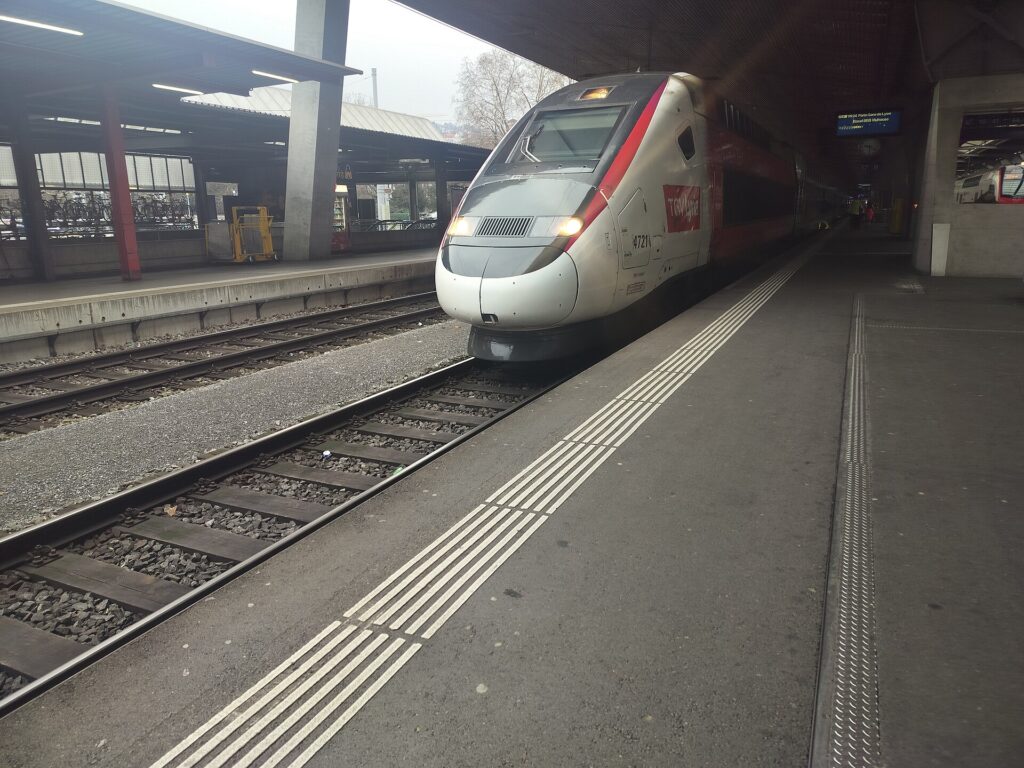
Lyria is the Franco-Swiss high-speed service from Paris Gare de Lyon. It runs to Geneva in a little over three hours, Basel in about three, Lausanne in under four and Zurich in around four. Book early: fares climb steeply as departure approaches.
3. Choosing where to cross the border
Which Lyria you take depends on where in Switzerland you are going:
- Geneva or Lausanne for Lake Geneva, Montreux and the GoldenPass line, and for Zermatt and the Valais via the Rhône valley.
- Basel for Interlaken and the Jungfrau region, Bern, and Lucerne — the most central gateway.
- Zurich for eastern Switzerland and Graubünden: Chur, St Moritz, and the start of the Bernina Express.
4. The Swiss network takes over
From your arrival station, Swiss trains connect to almost everywhere on this site, timed to meet one another. A Swiss Travel Pass starts working on Swiss trains — the Lyria journey from Paris is bought separately. Before you buy a pass, see Pass Check: it is not the all-inclusive ticket it is often sold as.
Before you go: for UK passport holders
Switzerland is not in the EU but is part of the Schengen area, so the same rules apply as for a trip to France:
- Your passport must have been issued less than ten years before the day you enter, and be valid for at least three months after the day you plan to leave.
- You can stay up to 90 days in any 180-day period across the whole Schengen area, not per country.
- The EU’s ETIAS travel authorisation is due to be introduced; check whether it applies on your travel dates before you go.
Rules change, and this page is not a substitute for the official source. Always check the GOV.UK foreign travel advice for Switzerland before you travel.
Why take the train at all?
City centre to city centre, the train is often not much slower than flying once you count the airport journey, security and waiting. You keep your luggage with you, you can work or read the whole way, and the emissions are a fraction of a flight’s. And in Switzerland, arriving by rail is simply the natural way in: the trains are the point.